Tourism in New Zealand - First Steps
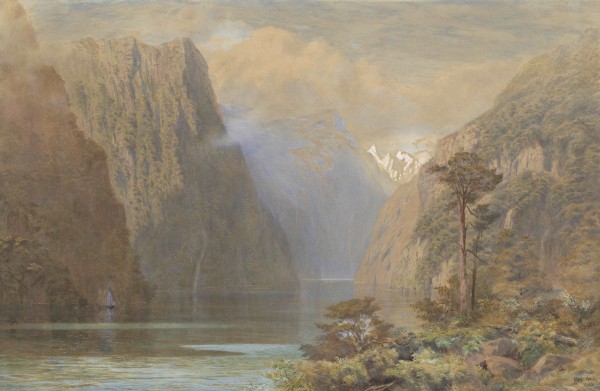
1. John Gully, Milford Sound 1883
Milford Sound Piopiotahi has captured our imagination for generations. It's remote, where the ocean meets mountains, where fast-flowing rivers and waterfalls cascade off mountain faces, where impenetrable rain forests hug the coastlines climbing up to be transformed into alpine tundra. Located in Fiordland National Park and Te Wāhipounamu the place of greenstone, the South West New Zealand World Heritage Area.
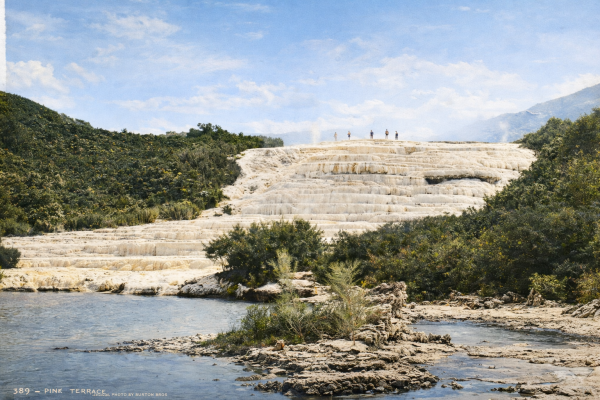
2. Burton Brothers, photographers of Dunedin, Pink Terrace c1885 (AI colour rendering).
Prior to 1886, the most celebrated tourist attraction in New Zealand were the Pink and White Terraces on the shores of Lake Rotomahana, today, about 30 minutes drive from Rotorua, which were destroyed in the Mt Tarawera Eruption of June, 1886. Rotorua's theraputic waters had led to the first government-run bath house, opening in 1882 as a health resort.
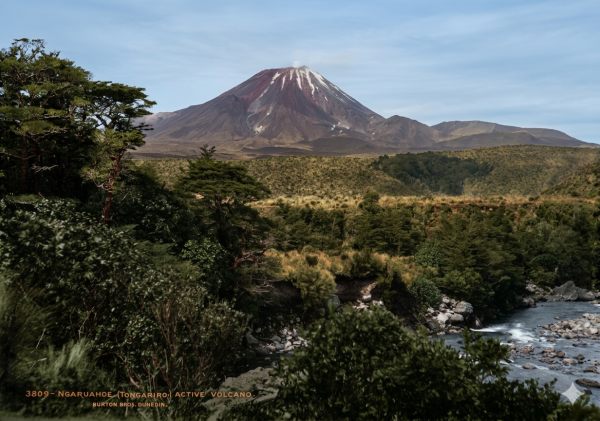
3. Mt Ngaruahoe, Tongariro National Park, Burton Bros. 1888 (colour rendering)
Many people in New Zealand were aware of the development of national parks in the United States. With the central plateau volcanoes being of great significance in 1886, Te Heuheu Tūkino IV of Ngāti Tūwharetoa had the mountains surveyed in the Native Land Court and then set aside as a reserve. Tongariro National Park was established.
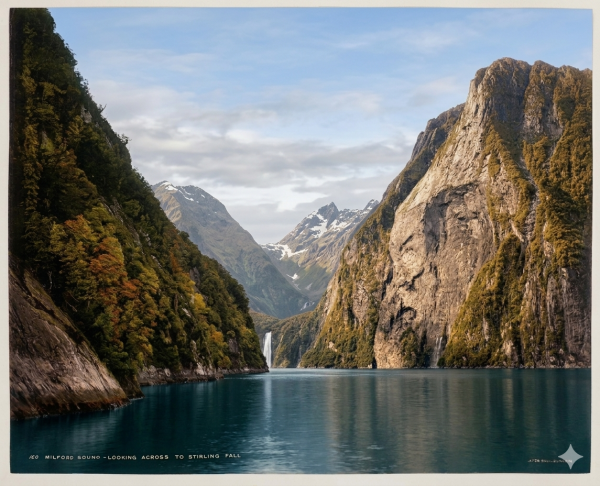
4.Milford Sound to Stirling Falls by Burton Bros, Dunedin, 1888 (AI colour rendering).
Milford Sound was important to Ngāi Tahu as a traditional source of greenstone - pounamu and routes through the mountains were established. Europeans did not enter Milford Sound until the 1820s and Captain Cook, who spent 5 weeks in Dusky Sound during his second voyage in 1773, did not navigate this area of Fiordland.
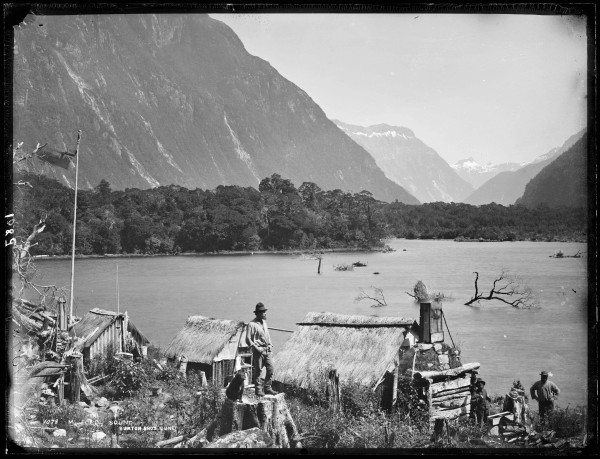
5. Donald Sutherland Arthur River, Milford Sound, 1882
Donald Sutherland arrived in Dunedin in 1863, just as gold was found in Gabriel's Gully. Sutherland jumped ship but abandoned his pursuit of gold and headed to the North Island. He then enlisted as a soldier during the New Zealand Wars, returned for a period to the West Coast gold fields, and in 1878 settled in Milford Sound, by the Bowen Falls to continue prospecting for gold. For many years, he lived as a hermit. In November, 1880 he discovered the Sutherland Falls. In 1888, the government paid him to cut a track to the Sutherland Falls.
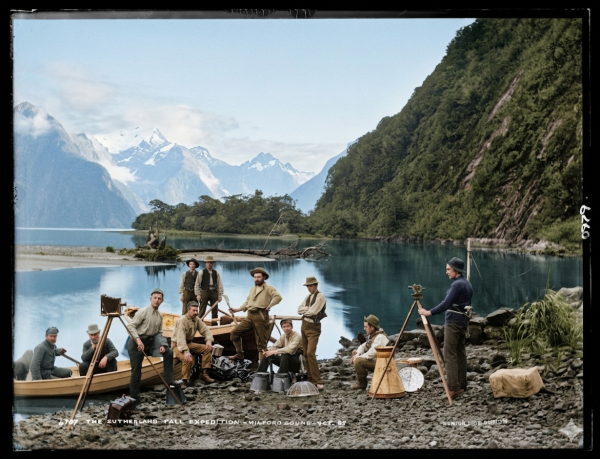
6. 1888 expeditions to the Sutherland Falls to verify Sutherland's claims (Burton Bros. colour rendering)
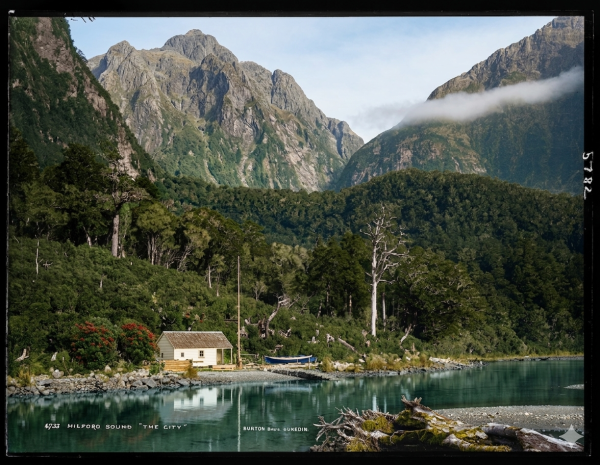
7. Milford Sound "The City", 1888 (Burton Bros. colour rendering)
In 1890, Sutherland married Elizabeth Samuel, a widow from Dunedin. With her funds, they bought land in Milford and built an accommodation house known as The Chalet. In 1922, this was purchased the Department of Tourism and Health Resorts.
From the Lake Te Anau north arm, Quintin McKinnon, another Scotsman, discovered an alpine pass to Milford Sound in 1888 which bears his name today. He became the first tour guide of the Milford Track. In 1890, a contingent of 45 prisoners were sent to Milford Sound to help form the tracks from Sandfly Point. Rain, rain, rain, soaked clothes and wrotting food, sandflies - a water-logged "open-air prison at the bottom of the earth" . The prison was closed in September 1892 and the goaler's quarters left behind as a tourist hut. [Davidson, J., (2023), Blood and Dirt, BW Books]
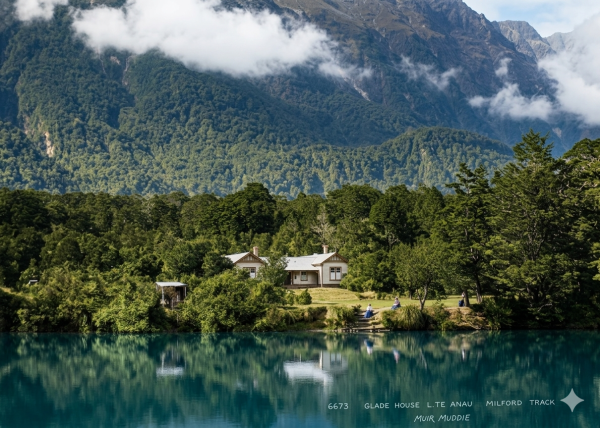
8. Glade House, Lake Te Anau North Arm, 1905 (Muir Muddie - new owners of Burton Brothers colour rendering)
In 1895, Glade House was built by John Francis Garvey and wife Louisa as an accommodation house on the banks of the Clinton River and the head of Lake Te Anau. A newer version of Glade House still exists today.
Menu from January 6 1931
The menu below is from Glade House Museum. The image was taken by Celia Hay 2026.
Soup Lentil
Hot: Rabbit & Bacon Pie or Stewed Steak & Onions
Cold: Corned Beef or Roast Mutton
Vegetables: Cauliflower, Green Peas & Potatoes
Sweets: Raisin Pudding & sweet Sauce or Apple Pie or Sago Custard & Apricots or Gooseberry Flumery (mousse set with gelatine) & Cream
Tea & Coffee
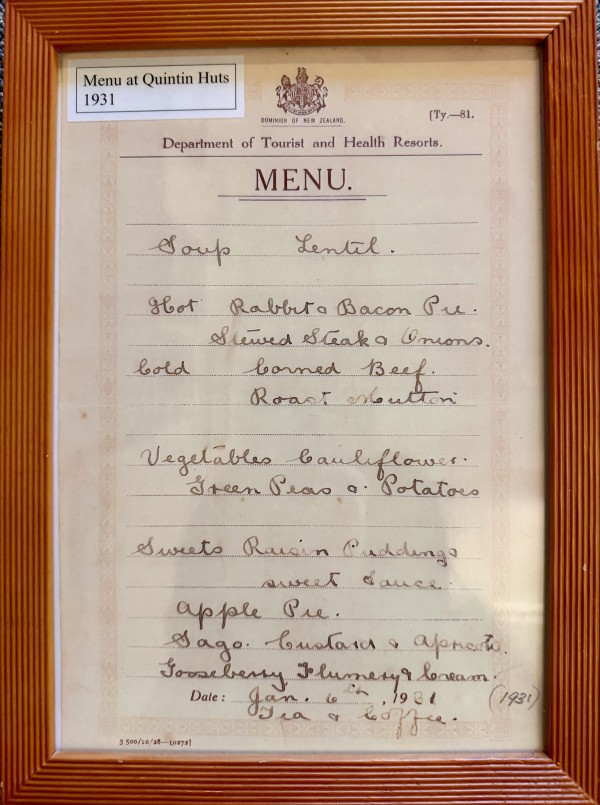
Department of Tourist and Health Resorts (1901)
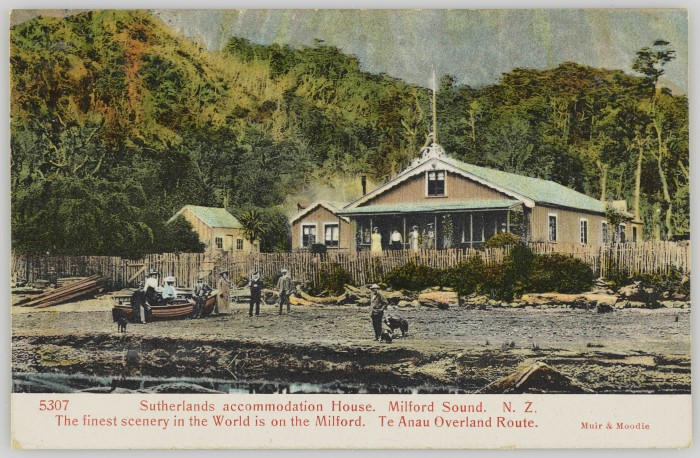
9. Sutherland's Accomodation House, Milford Sound, New Zealand, 1905
By 1901, the New Zealand Government established the Department of Tourist and Health Resorts – the first dedicated central government tourist department in the world to run hotels around New Zealand. In the 1950s was later re-named THC Tourist Hotel Corporation of New Zealand. Led by Thomas Edward Donne, the department promoted 'tourist services and attractions to both domestic and international audiences though lantern-slide lecture tours, press articles, the distribution of post cards, photographs, guidebooks and pamphlets, and displays at overseas trade fairs...'
Donne introduced red deer, wapiti (large, round horned deer), Canada geese and salmon to make New Zealand a ‘sporting paradise’’. Chamois (alpine antelope-goat) and tahr (Himalayan goat) to add charm to alpine landscapes. All of these, apart from salmon, are now considered a threat to New Zealand's ecology along with other introduced mammals such as possums, rats, and stoats. Read about Predator Free 2050.
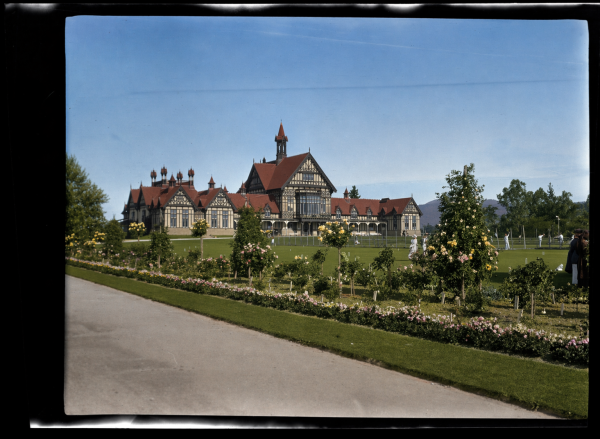
10. Bath House building in the Government Gardens, Rotorua, 1922-1923
In these early years, the jewel in the crown was Rotorua, a centre of Māori entrepreneurship. Resorts were established in Te Aroha (Bay of Plenty), Hanmer Springs (North Canterbury), The Hermitage hotel at Aoraki/Mt Cook (first building in 1884) and bought by the government in 1896 with management take over by the Department of Tourist and Health Resorts. Other centres of tourism were Taupō, Lake Waikaremoana, Te Puia Hot Springs, Waitomo, Milford Sound, and Queenstown.
International tourism, however did not prove to be the ‘gold mine’ primarily due to New Zealand's isolation and international events such as World War 1 but domestic tourism grew solidly.
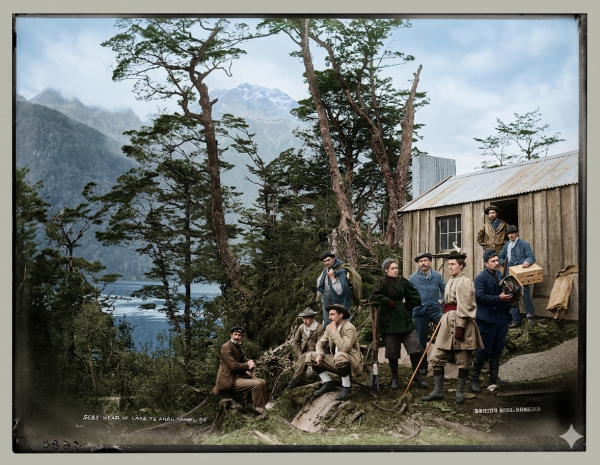
11. 1895 Walkers setting off from the head of the Lake Te Anau (Burton Bros.)
If you walked the Milford Track, you would need to return on the same route as there was no road access to Milford Sound. This finally changed in 1953 with the opening of the Homer Tunnel.
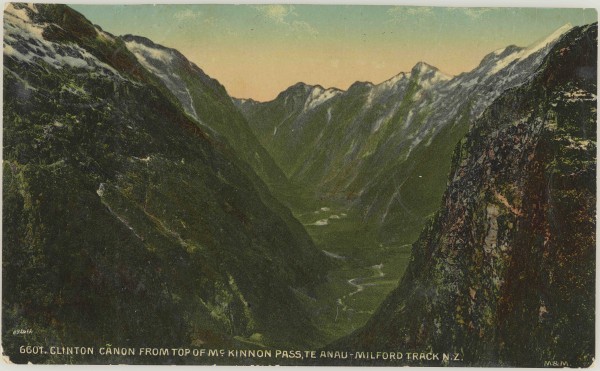
12. Clinton Canon from top of McKinnon Pass, Te Anau, Milford Track, 1908, Clinton, by Muir & Moodie. Purchased 1998 with New Zealand Lottery Grants Board funds. Te Papa (PS.001888)
Celia's blog on Walking the Milford Track, April 2026.
Homer Tunnel opens access to Milford Sound
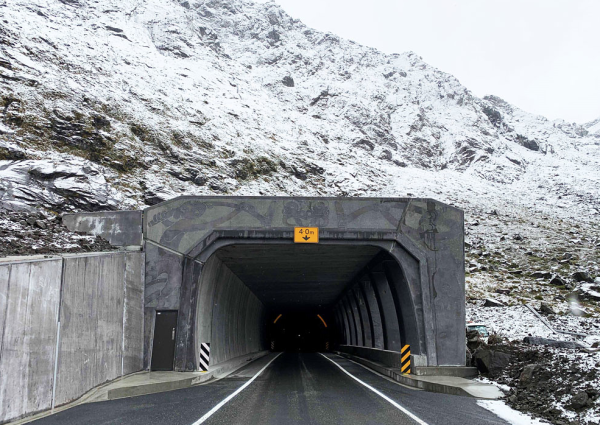
The Homer Tunnel is named after William Henry Homer (1838–1894) who suggested a road tunnel would open access to the tourism attraction of Milford Sound. Until this point, to get to Milford Sound, people could visit by sea or on foot, via the McKinnon Pass on the Milford Track.
Drilling through the Darran Mountain Range at the Homer Saddle was slow and treacherous process. Construction commenced in 1935 but with holdups due wet weather, avalanche risk and World War II, the tunnel was not completed until 1953. Today, the 1230 metre tunnel remains one-way, has a gradient down of 1:10 and is managed by traffic lights. Read more about the construction here.
Until the late 1960s, the Milford Track remained for the exclusive use of guests of the THC Tourist Hotel Corporation.
In 1965, the Otago Tramping and Mountaineering Club challenged this exclusive access to the Milford Track with a FREEDOM Walk over the Easter holiday. "43 club members donned their boots, and their fighting spirit. Calling themselves Freedom Walkers, in solidarity with Martin Luther King’s Freedom Marches then happening throughout America, they tramped through the rain and into the history books. Read more here.
New era of hiking in New Zealand
FREEDOM Walkers on the Milford Track stay at Clinton Hut, Lake Mintaro Hut and Dumpling Hut in the Arthur Valley. The Routeburn Track has also been enormously popular offering both Freedom Walking and Guided options and the Department of Conservation continues to add more tracks to the Great Walks of New Zealand.
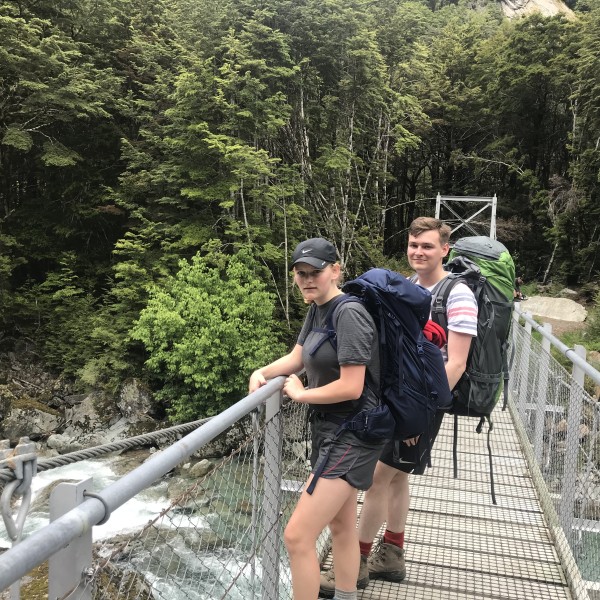
Alice and Oliver Hay on the Routeburn Track.
Celia Hay
19 April 2026
Images used in the article have primarily been sourced from the digital archives of Te Papa Tongarewa Museum of New Zealand.
1. Milford Sound, 1883, New Zealand, by John Gully. Gift of Mrs F. Hall, England, 1946. Te Papa (1946-0005-1)
The colourisation of the images below were created using Gemini AI [#3]
Colour-rendered image of Milford Sound, looking across to Stirling Fall, circa 1888, Dunedin, by Burton Brothers, Alfred Burton. Purchased 2014. Te Papa (O.041332). The colourisation of this image was created using Gemini AI [#3]
2. Colour-rendered image of Burton Brothers, photographers of Dunedin, Pink Terrace c1885 (AI colour rendering).
3. Colour-rendered image of Mt Ngaruahoe, Tongariro National Park, Burton Bros. 1888 (AI colour rendering)
4. Colour-rendered image of Milford Sound, looking across to Stirling Fall, circa 1888, Dunedin, by Burton Brothers, Alfred Burton. Purchased 2014. Te Papa (O.041332).
5. Donald Sutherland Arthur River, 1882 Milford Sound, 1882, Dunedin, by Burton Brothers, Alfred Burton. Purchased 1943. Te Papa (C.015801)
6. Colour-rendered image Expedition to the Sutherland Falls to verify Sutherland's claims, 1888 (Burton Bros. colour rendering)
7. Colour-rendered image Milford Sound "The City", 1888 (Burton Bros. colour rendering)
8. Colour-rendered image Glade House, Lake Te Anau North Arm, 1905 (Muir Muddie - new owners of Burton Brothers colour rendering)
9. Postcard: Sutherland's Accomodation House, Milford Sound, New Zealand, 1905, Milford Sound, by Muir & Moodie. Purchased 1998 with New Zealand Lottery Grants Board funds. Te Papa (PS.000968/02)
10. Colour-rendered image Bath House building in the Government Gardens, Rotorua, 1922-1923, Rotorua, maker unknown. Te Papa (A.016106)
11. Colour-rendered image of Head of Lake Te Anau, April 1895, 1895, Dunedin, by Burton Brothers. Purchased 1943. Te Papa (C.017344)
12. Postcard: Clinton Canon from top of McKinnon Pass, Te Anau, Milford Track, 1908, Clinton, by Muir & Moodie. Purchased 1998 with New Zealand Lottery Grants Board funds. Te Papa (PS.001888)
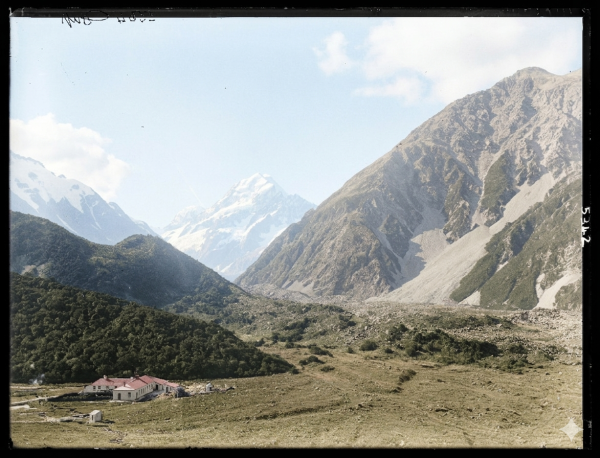
Colour-rendered image of Mount Cook and first Hermitage, 1893, Dunedin, by Burton Brothers, George Moodie. Te Papa (C.015342)
The colourisation of this image was created using Gemini AI [#3]